New Year, New Stories: 'The Forever Witness,' 'Burned' & More


After a three-year adventure in Seattle, I’ve returned to Southern California – and I am excited to report that I came back with a great new true-crime story to tell.

My next book will be The Forever Witness, a story that begins in the Pacific Northwest but that affects us all. It’s based on a 32-year-old murder mystery set north of Seattle, where the bodies of a young couple on a weekend jaunt from Canada turned up on separate rural roads many miles apart.

The focus of hundreds of newspaper headlines across the decades and thousands of hours of police work, the case lacked suspects, witnesses, motive or useful evidence. The murders seemed unsolvable – until a relentless cold-case detective used a home DNA test kit to track down the killer at last, forcing a ground-breaking courtroom showdown.

The Forever Witness, due out later this year from Dutton Books, is not just a true crime thriller but also a story with broad implications for us all, miraculous and dark in turns as it mixes science, genealogy, commerce and murder in new and disturbing ways. The future of privacy, the future of health care, even the future of what we consider and call “family” is at stake, as the unintended consequences of the home DNA testing craze continue to unfold.

Stay tuned for more about The Forever Witness in the months to come.

BURNED AT LASTBOOKSTORE.jpeg

My 2019 began with the publication of Burned: A Story of Murder and the Crime That Wasn’t, my return to the true-crime genre. The legal battle at the heart of the book has continued to evolve. Next step: the California Supreme Court.

This investigative narrative of a young mother imprisoned for life without parole, seeking to prove her innocence after being convicted of killing her three children in a house fire, also has been optioned by Lion Entertainment for a television series.

Here’s an opinion piece I wrote for the Los Angeles Times about the flawed forensic science and false evidence behind Jo Ann Parks’ conviction and many others nationwide: “Bad forensic science is putting innocent people in prison.

Meanwhile, the California Innocence Project continues to seek Parks’ exoneration through a petition now pending before the state’s highest court.

The True Crime Book Club at the Last Book Store is reading Burned and hosting a discussion this month. Author James Bartlett will lead the conversation about the book and the work of the California Innocence Project, and I’ll be there, too.

Join us: The book club meets at 7:30 p.m. on Tuesday, Jan. 21, at the Last Book Store, 453 S Spring St., Los Angeles. More info.

GARBOLOGY COVER COPY.jpeg

Garbology and more

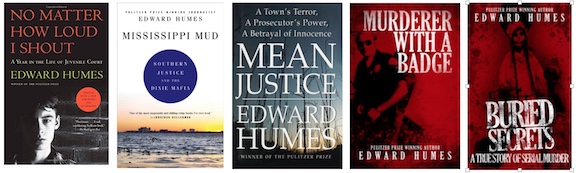
This year also saw film and television projects under development based on three of my other true-crime books: Mississippi Mud, Mean Justice and Buried Secrets. (I hope to have more news on these projects soon.)

And yes, I’m still talking trash. I’ve enjoyed the opportunities to join conversations about my book, Garbology: Our Dirty Love Affair with Trash, discussing our way back from waste at college campuses and communities across the country.

In June, I took a deep dive into recycling misconceptions and the need for new approaches in Sierra Magazine. "Just because something is recyclable does not necessarily mean that it's healthy or has a small footprint," says David Allaway of the Oregon Department of Environmental Quality. "Recycling is generally beneficial, but just because something is recyclable or compostable doesn't necessarily make it the lowest-impact choice for the environment."

On March 28, I’ll be discussing Garbology and the impact of waste on oceans and the climate at a forum sponsored by the League of Women Voters in Pasadena. Check my Facebook Garbology page in the coming weeks for details.

Thank you for taking interest in my work and I invite you to connect on Twitter, Facebook or through this website.

I wish you all a happy, healthy, prosperous 2020.


Burned is Here: Why I Love Writing Nonfiction

My new book, Burned, comes out today. One of my favorite parts of writing nonfiction is the opportunity to unravel a mystery while immersing in the worlds of the people and subjects I tackle. During the past two years I’ve attended arson school and learned from real-life CSI and fire experts at the top of their game. And I took a deep dive inside the world of the most unique criminal law practice I’ve ever encountered: the California Innocence Project.

BURNED quote card 1.jpg

In the bowels of a San Diego law school, the project’s lawyers, volunteers and students sift through an ever-growing mountain of letters from men and women convicted of terrible crimes. Buried in this flood are a slim number of cases where justice went awry.

That’s how I encountered Jo Ann Parks, convicted of a triple murder and sentenced to life in prison without possibility of parole. A Los Angeles jury found Parks guilty of trapping her children inside her house, then setting it aflame.

Since that terrible night thirty years ago there has been a revolution in the science of fire. Much of what was thought to be gospel in 1989 has been revealed to be myth and guesswork disguised as science. The California Innocence Projects reinvestigated the case and argues Parks should go free.

The question of Jo Ann Parks’ fate forms the central “whodunnit” of Burned. Beyond the question of her guilt or innocence, her case also takes readers on a larger journey into the world of forensic science—the CSI marvels lionized on TV, but that sometimes contain far less science and certainty than advertised. [My Publishers Weekly Q&A is here, and a full review of Burned is here. You can buy Burned from the bookseller of your choice here.]

It’s always a thrill when a new book comes out. But this story also marks my return to crime writing, which started when I was a newspaper reporter covering the courthouse and continued with my first five books. It’s been a while since I wrote Mississippi Mud and No Matter How Loud I Shout: A Year in the Life of Juvenile Court, though they remain two of my best-selling books. When I came across the stories behind Burned, I knew it was time to return to the true-crime book world I love.

true crime gallery.jpeg

Speaking of Mississippi Mud, I received some exciting news recently: the movie version of this tale of murder, the Dixie Mafia, and a daughter’s search for justice is moving forward in 2019! Stay tuned for more on that.

It’s not all crime all the time for me, though. These days I split my time and work between Seattle and Southern California. It’s also been another great year for Garbology: Our Dirty Love Affair With Trash, which so far has been adopted for 24 community or campus reads, from Ranchos Palos Verdes in California to the city of Portland to the Georgia Institute of Technology. This year I talked trash at Purdue University in Indiana and The College of Wooster in Ohio, where every freshman read Garbology and did projects related to waste and the environment throughout the school year.

Finally, a note of thanks: I appreciate everyone who has taken the time to send me a letter or email this year, to comment on something I’ve written, to make a timely suggestion, or to point out a story, event or insight I otherwise would have missed. My readers are the best! I can’t thank you enough for taking an interest in my work.

[For media inquiries or to request an event during my upcoming book tour, contact Maria Whelan at Penguin Random House publicity.]


My Fall Crime Reading List

My favorite crime books — fiction and nonfiction alike — hook readers with more than a compelling plot and mystery. They also develop a deep and atmospheric sense of place. Think John Berendt’s Savannah in “Midnight in the Garden of Good and Evil,” or Raymond Chandler’s noir Los Angeles in any of his Philip Marlowe books.

Now that I’ve finished writing my next book, I have more time to dive into the stack on my nightstand. Here’s some of what I’ll be reading this fall:

crime books 2.jpeg
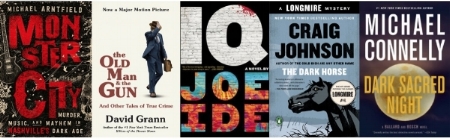
  • As a setting, I’m fascinated by the city of Nashville, and so I can’t resist “Monster City: Murder, Music and Mayhem in Nashville’s Dark Age,” Michael Arntfield’s nonfiction account of multiple serial killers stalking the nation’s country-music capital.

  • Also in my true-crime queue: “The Old Man and the Gun and Other Tales of True Crime,” an anthology from David Grann, author of “Killers of the Flower Moon.”

  • On the crime fiction front, I’ll be picking up Michael Connelly’s latest Harry Bosch mystery, Dark Sacred Night, when it comes out the day before Halloween. I love the setting for this one: Bosch returns to his old Hollywood stomping grounds in the company of the lead character of Connelly’s other detective series, Renée Ballard.

  • Janet Maslin’s review of Joe Ide’s third book, “Wrecked,” made me want to dive into Ide’s world. But obsessive as I am, I have to go back and read his first two books first, starting with “IQ.” I can’t wait to see what he does with the setting of East Long Beach — my own home-base when I first moved to Southern California.

  • Speaking of obsession, I have been speeding through the Walt Longmire series of books by Craig Johnson, with their beautifully rendered portraits of Wyoming life and landscape. I have a dozen books to go before I reach Johnson’s newest installment, “Depth of Winter.” Right now I’m on the fifth, “The Dark Horse,” which I’m listening to in the Audible version, expertly narrated by George Guidall, speaking just how you’d expect Walt would sound if he was kicking back on his porch with you and a couple of ice-cold Rainiers.


He'll Try Anything To Free These 12 Prisoners

Imagine you’re a lawyer with 12 clients in prison you believe to be innocent. How do you get a busy governor to pay attention to your pleas for clemency?

If you’re Justin Brooks, Director of the California Innocence Project in San Diego, you battle in court, you tweet Gov. Jerry Brown daily, and when that fails, you walk. Really, really far.

Brooks will mark the governor’s last 100 days in office by walking 100 miles from Berkeley to the state Capitol in Sacramento to call attention to the “California 12.”

His team has already won freedom for five of them in the courts. A bid to overturn a sixth’s murder conviction awaits a Los Angeles judge’s decision: the case of Jo Ann Parks, chronicled in my upcoming book, Burned. New evidence in the arson-murder case against Parks could set her free, although prosecutors are fighting hard to prove she deserves her life-without-parole sentence. So Brooks is simultaneously needling the governor to grant parole or commutation to her, along with the other members of the California 12 still behind bars.

This is not the first time Brooks has let his feet do the talking: Five years ago, he led his staff on a 712-mile trek from San Diego to Sacramento to introduce the California 12 to the world.

“To get the governor to grant clemency,” Brooks says, “you have to get his attention.”

'Garbology' Students Share Their Trashy Tips

I’m getting ready to visit the College of Wooster, where the freshmen class is reading Garbology. I’m already so inspired by the ways students there are challenging themselves to be less trashy. Check out this great video, where a Wooster student named MacKenzie explains how she made her love of coffee less wasteful with reusable mugs and a reusable capsule for her single-cup coffee maker. This even saves her money!

“I’m still getting my morning coffee,” she says, “and I’m creating a lot less waste.”

Robert, meanwhile, says he is avoiding all food packaged in plastic. Emma has ended her addiction to plastic water bottles. I can’t wait to see what other ideas and questions the Wooster students come up with when I visit their Ohio campus on September 26-27.

I love it when Garbology readers reach out to share ways they are being less wasteful — everything from participating in beach cleanups, to composting table scraps, to buying used things whenever possible. One Purdue University Northwest student told me how she created a Bag Monster costume out of hundreds of plastic bags. She it wears it on campus and at community events to raise awareness about the dire effect plastic waste is having on the world’s oceans.

So I’ve started keeping a list of great suggestions from readers who reuse, reduce, recycle, and refuse unwanted items. I’ll be posting the list on my site later this fall and I welcome your trashy suggestions and photos, too. Send me a message at ehumes@edwardhumes.com and I’ll add your suggestions to the list!

Will New Science Set a Mother Free After 26 Years in Prison?

I’ve been away for a while, immersed in my next book. But I’m back now, and eager to tell you about Burned, which will be published by Dutton Books in January. 

A few days ago I watched the conclusion to a court hearing on the murder case at the heart of Burned. It was a nail-biter, with the judge’s decision yet to be revealed. Here’s what he’s dealing with:

On an April night in 1989, three small children perished in a Los Angeles apartment fire. Their twenty-three-year-old mother, Jo Ann Parks, escaped unharmed, the sole survivor and only eyewitness. Though they at first believed the fire had been a tragic accident, arson investigators

soon decided that Parks had sabotaged wiring, set several fires herself, and even barricaded her four-year-old son inside a closet to make sure he could not escape the flames. The prosecutor on the case pronounced Parks one of the most monstrous killers in Los Angeles history, motivated by a desire to be free of parental responsibilities and eager to cash in by suing her landlords. Convicted through the power of forensic fire science, Parks remains in prison to this day, sentenced to life without possibility of parole. 

More than a quarter century later, however, there has been a revolution in the science of fire. Much of what was thought to be gospel in 1989 has been revealed to be myth and guesswork disguised as science. Now the Parks case has been reopened and re-investigated, the subject of an intense legal battle stretching over ten months in Los Angeles County Superior Court. Lawyers at the California Innocence Project hope to prove that false assumptions, tunnel vision and outright bias turned a terrible accident into a wrongful murder conviction. Parks, they say, has spent more than half her life in prison for a crime that never happened. 

Will Jo Ann Parks be exonerated? Should she be? Is she “Patient Zero” in an epidemic of wrongful arson convictions waiting to be overturned? Or can prosecutors come up with enough evidence from the ashes to make sure she dies in prison? No matter how this case turns out, someone will be left burned. 

This is my first true crime book in a while. I’m jazzed to be returning to the genre that started my career, with a murder mystery and tale of possible injustice that keeps you guessing until the very end. Stay tuned for more….

Read an excerpt of Burned here.